teisipäev, 31. jaanuar 2012

Ei mingeid üllatusi/No surprises

Seekord ei mingeid üllatusi: hall sviiter/tuunika. Pärast eksperimente ja lopsakaid mustreid on jälle tahtmine teha midagi minimalistlikku. Lõnga sain Tartu mnt poest Wool and Woollen. Nimega Houston, poolenisti polüamiid, ülejäänud on vill ja alpaka. Näeb välja nagu mohäär, kuid pole karvane.
No surprises this time: a gray sweater/tunic. After experimenting and busy stitch patterns I want to make something minimalist. I got the yarn in Tartu road yarn shop Wool and Woollen. The yarn is called Houston, half polyamide and the other half wool and alpaca. It looks like mohair, only without being hairy.

Minimalism minimalismiks, kuid mõni väike detail on ka. Keskel jookseb pahempidiste riba.
It may be minimalism all right but a small detail added. You see a stripe of purl stitches in the middle.

 Varsti hakkan varrukadi kuduma, seekord pole mul kahtlust, et tuleb pikk varrukas. Varruka keskel on samasugune pahempidine riba.
I will soon start the sleeves and this time I have no doubts that these will be long sleeves. In the middle of the sleeve there is the same stripe of purl stitches.

pühapäev, 29. jaanuar 2012

Seletus/Explanation

Lubatud seletus tuleb. Asi on lihtne. Tuleb kududa 2 kolmnurkset rätikut, alustades klassikaliselt nii-öelda kaelast (musta joone keskelt). Miks just nii? Aga siis asetsevad värvid diagonaalselt. Punane joon näitab "rätiku" keskmist silmust, lillad jooned näitavad värvide jaotust.
The promised explanation is coming. It is fairly simple. You have to knit 2 triangualr shawls starting from the mid-neck, so to say, in a classical way (this would be from the middle of the black line). Why in this way exactly? Because in that case the colours will be distributed diagonally. The red line shows the central stitch of the "shawl" and the purple lines show how the colours are situated.


Niisiis, tuleb rätikud valmis kududa, aga mitte maha kududa. Rätiku laius (must joon) = seeliku laius (puusade ümbermõõt + veel mõni sentimeeter). Seejärel tuleb nad asetada teineteise suhtes nii, nagu pildidl. Nüüd tuleb kokku kududa (kolme vardaga maha kududa) rohelisega tähistatud küljed omavahel (saame risttahuka) ja sinisega tähistatud küljed jälle omavahel (tulemus on silinder).  Ja mis on silinder? See on tavaline sirge seelik, muud midagi. Kui silinder on olemas, tuleb otsustada, kus on ülemine äär, ja üles korjata silmused poole numbri võrra peenemate varrastega (pärast kahandasin veel u. 10 % silmuseid) Siis kududa värvel (kummipaela tunnel) ja panna kummipael.
Thus, you have to knit the shawls but don't bind off! The width of the shawl (the black line) = the width of the skirt (hip circumference plus some centimetres/inches for better fitting). After that you have to place them in the way they are in the picture. Now you have to knit them together (3 needle bind off): along the green lines (you'll get a parallelepiped) and then along the blue lines (the result is a cylinder).  And what is a cylinder? In fact, it is a usual straight skirt, nothing else. Once you have the cylinder, you have to decide which edge is the upper one and to pick up stitches with smaller needles (then I decreased about 10 % of the stitches). Then you have to knit the case for an elastic band and to insert the band.
Kaks olulist märkust. (1) Seelik on sirge. Kui teile ei sobi sirged seelikud, siis see konstruktsioon ei sobi. (2) Pikkus ja laius on omavahel seotud (mõelge kolmnurkse rätiku peale: mida pikemaks koote, seda laiemaks see muutub). Tõsi küll, värvel teeb pisut pikemaks ja soovi korral võib alla ka mingi ääre kududa, aga siis peaks kõvasti mõtlema, ega see üldmuljet ei riku (värvide mõttes).
Two important observations. (1) The skirt is straight. If straight skirts do not suit you, this is not your construction. (2) The width and the length are interconnected (think about triangular shawls: the longer you make a shawl, the wider it becomes). Of course you can lengthen the upper part (the waistband) and, if you wish, you can add a bottom edge but then you have to think it over because it might upset the balance (meaning the distribution of the colours).
Mõtlen edasi, kuidas saavutada samasugune värvijaotus, aga et (1) äär ei oleks sakiline ja (2) pikkus ei sõltuks laiusest. See oleks aga hoopis teistsugune konstruktsioon.
I am pondering now how to achieve the same colour distribution but (1) the bottom edge should not be in zigzag and (2) the length would be independent from the width. However, this would be an entirely different construction.

laupäev, 28. jaanuar 2012

Hoopis seelik/It is a skirt, after all

Nüüd on näha, et see on hoopis seelik!
Now you can see that it is a skirt after all!


Väljas on -11 kraadi (hommikul oli isegi -15). Seega väljas pildistamine on välistatud. Sees on aga valguse probleem. Siiski Ave abiga sai mõned pildid.
It is -11 outside (in the morning it was even as cold as -15). Thus, photoshoot outdoors is out of question. But there is a problem of light indoors. Still, with Ave's help some pictures were taken.
Ravelrys on selle projekti nimi "Kaherätiseelik". Kas oskate ära arvata, miks?
It is called "Kaherätiseelik" (Two shawl skirt) on Ravelry. Can you guess why?
Pildid/Pictures: Ave
Lõng/Yarn: YarnArt Magic fine (50 % akrüül/acrylic, 50 % vill/wool, 100 g/300 m), < 200 g.
Vardad/Needles: 4 mm, 3,5 mm.
Seda lõnga ma teist korda ei ostaks. Ideaalne lõng sellise seeliku jaoks oleks Aade Lõng või leedu Teksrena või midagi analoogset. Teadsin seda kohe algusest, aga mõtlesin, et värvide pärast ja eksperimendi mõttes võiks osta. Kui lugejad soovivad, võin täpsemalt rääkida konstruktsioonist.
I would not by this yarn again. An ideal yarn for such a skirt would be Aade Lõng or Lithuanian Teksrena or something of the kind. I was aware of it in the beginninb but decided to go after it because of the colours and because I wanted to do the experiment. If the readers wish, I can discuss the construction next time.

kolmapäev, 25. jaanuar 2012

See ei ole rätik-2/This is not a shawl-2

Head lugejad, see, mida all näete, ei ole tõepoolest rätik. Ütlen kohe, et see pole hõlmikjakk nagu siin (mille kohta pidin alguses ka ütlema, et see ei ole rätik). Võib-olla peaks tekitama uue sildi "mitterätik" või "ebarätik"? Kuidas teile tundub?
Dear readers, what you see below is indeed not a shawl. I am saying this is not a wrap jacket as one here (about which I had to warn in the beginning that this was not a shawl). Maybe I have to make a new tag "non-shawl"? What do you think?
Loodetavasti saan varsti valmis, siis saab rohkem rääkida. Kui ei õnnestu, siis on ka põhjust rääkida, mis valesti läks.
Hopefully it will be finished soon and then I can tell more. If it does not work out, then again there is a reason to talk what went wrong.

pühapäev, 22. jaanuar 2012

Rätik valmis/The shawl is finished

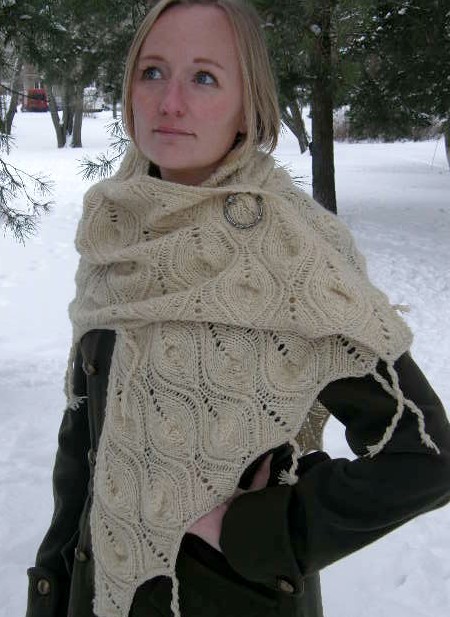
Rätik on valmis! Täna oli Kristiina juures kooskudumine (Kristiina, Ave ja mina) ja, kuna Avele sobib selline värv, palusin poseerida. Ave oli lahkesti nõus. Suur tänu!
The shawl is finished! Today we knitted together at Kristiina's place (Kristiina, Ave and myself) and, as this colour suits Ave, I asked her to model. She was very kind to agree. Thanks a lot!


 Juhin tähelepanu, et rätiku muster on kahepoolne, võib kanda ka nii, nagu alumisel pildil.
Please note that the stitch pattern is reversible and you can wear the shawl as in the picture below.
 See on keskmise osa pilt n-ö pahemalt. Täiesti ootamatult on tekkinud selline muster.
This is the central stitch from so-called wrong side. Quite unexpectedly, this pattern emerged.

Lõng/Yarn: Saarema villane /Saaremaa wool 8/2 (~ 100 g/ 250 m), ~250 g
Vardad/Needles: 4,5 mm

neljapäev, 19. jaanuar 2012

Kasvab aeglaselt/Slow progress

Edeneb väga aeglaselt. Kudum on juba raske, read on suht pikad.
The progress is really slow. What I have already knitted is heavy, the rows are quite long.
Siin on pilt keskjoonest, kust "lehed" välja kasvavad.
Here is a picture of the central line from which "the leaves" grow.
Keskjoone pikkus on praegu pisut üle 50 cm. Kindlasti venib rätik pärast pingutamist. Aga kuna plaan on kududa suurrätt, siis on veel kõvasti tegemist. Pildistasin tugitoolil, et oleks aimu suurusest.
The length along the central line is slightly over 50 cm now. Of course, after blocking the shawl will grow. But since the plan is to make a big shawl ("suurrätt" is a special term in Estonian, meaning "big kerchief"), there is a lot to knit. I made this picture on the armchair to give you an impression of the current size.

teisipäev, 17. jaanuar 2012

Mis see on?/What is it?

Mis see on? Mingi sürrealistlik maastik?
What is it? Some kind of surreal landscape?

Tegelikult see on kolmnurkne rätik (kingituseks). Lõng on Saaremaa vill 8/2, kuid pean ütlema, et see on Aade Lõng 8/2-st jämedam. Koon vardaga 4,5 mm. Proovisin ka 5 mm-ga ja olekski selle juurde jäänud, aga keeruga parempidised silmused olid liiga lõdvad. Nii et jäi 4,5 mm.
Actually, it is a triangular shawl (a present). The yarn is Saaremaa wool 8/2 but it I have to say that it is thicker than Aade Lõng 8/2. I am using 4.5 mm needles. I tried 5 mm as well and would have used them but stitches knitted through back loop were too loose. So 4.5 mm it is.